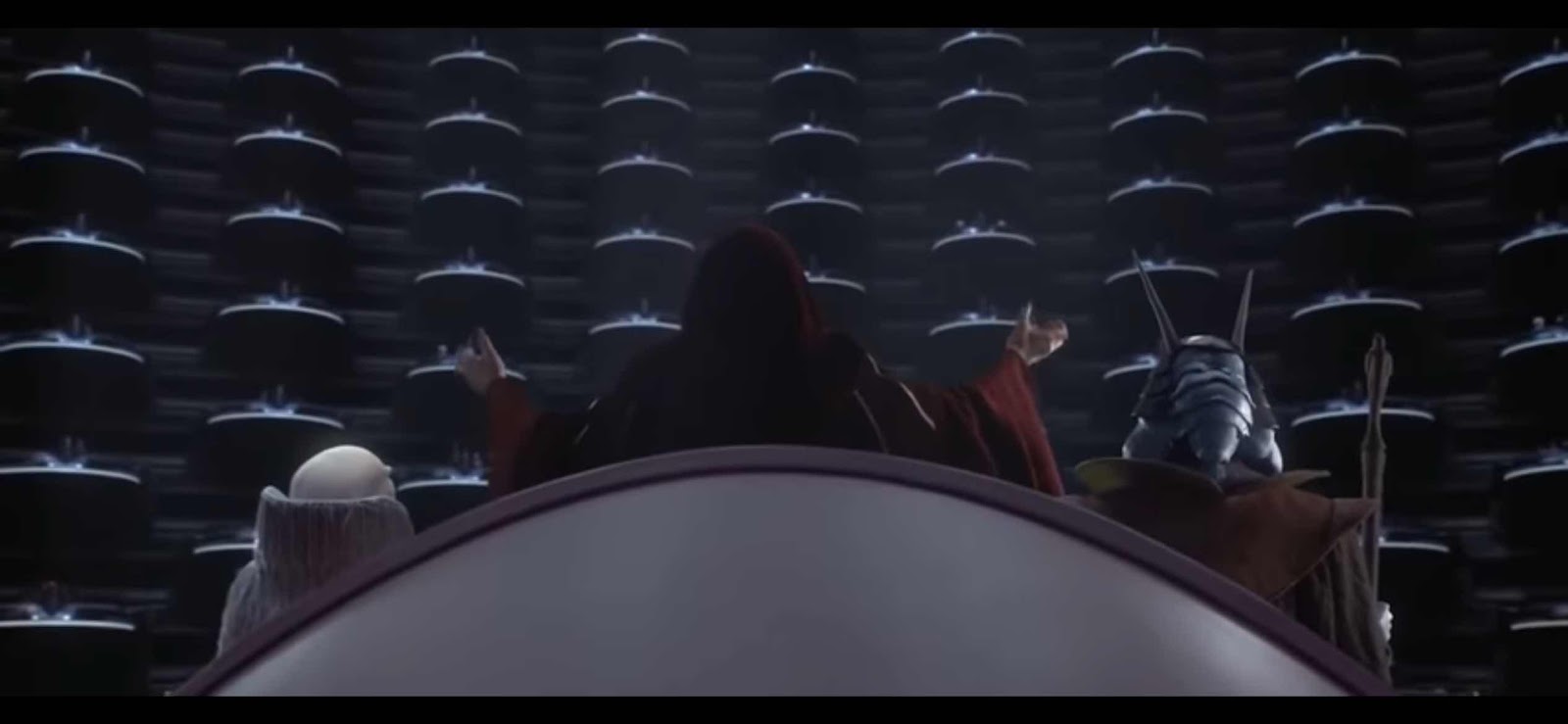
This past week has got me thinking about the Space Wizard series, Star Wars, a lot. For obvious reasons. At its core, it’s a story about the dangers of fascism, and the importance of fighting for and preserving democracy.
A couple weeks ago, I went to the Ronald Reagan Library for the Star Wars exhibit. “Star Wars” was what the Media called Ronald Reagan’s Strategic Defense Initiative. Eventually, Reagan embraced it. He called the Soviet Union an “Evil Empire” (I know. A Republican President who hated Russia. Crazy, right?) And Americans celebrated.
You know for a fact George Lucas took this personally and was disgusted. The villain of the entire saga, Palpatine, was based on Richard Nixon. A Republican. The Empire was based on the U.S. Military. The Rebels were based on the Viet Cong. The Jedi were hippies. They were very clearly anti-American imperialism. And yet here, Americans saw those movies and thought they were the Rebels, and everyone who opposed them was the Empire.
The Original Trilogy is a feel good story. Yes, it’s Rebels fighting fascism. But it ends with the Rebels winning. We don’t know how the Empire came to be or how Palpatine came to power in the first place. All we know is that the Empire is evil and the Rebels need to beat him.
Lucas saw that many fans of the original trilogy saw themselves as Luke Skywalker fighting for the Rebels, unaware that they’re actually Darth Vader, fighting for the Empire.
And that’s why he made the prequels. That’s why he made them so different from the original trilogy. Instead of a fun, escapist adventure with Joseph Campbell’s Hero’s Journey model, they were a Shakespearean tragedy about a sweet little child who wanted to help people, but was corrupted by the system and society around him to become a weapon for it.
George Lucas made Star Wars to speak to young people. To make an impression on them. He knew that they didn’t get the message.
He made the prequels not for the generation who grew up with the originals. He made them for my generation. He knew the world we were growing up in. He knew the Empire had taken over. And that the only opposition to it were neoliberal elites who are out of touch with the people. The Jedi Knights, who are supposed to be the guardians of peace and justice in the galaxy, lived in a tall tower surrounded by power hungry politicians and greedy opportunists. They allowed complete morons like Jar Jar Binks to be elected Senator. Even though his only
Political experience was being a General in a battle, losing that battle, and giving up. But thanks to Anakin, the droids shut down. And the Goongas won. And Jar Jar took the credit. He got elected Senator, and helped give Palpatine emergency powers. Suddenly, Ted Cruz getting re elected to Senator in Texas after abandoning them in a hurricane doesn’t sound so hard to beoieev, doesn’t it?
The Jedi in the prequels were the complete opposite of how Obi-Wan described them to Luke.
The way Obi-Wan talked about the Jedi to Luke is the same way our parents and teachers talk to us about American history. “Our Founding Fathers were warriors for freedom and justice!” A very idealistic, very wish washy feel good version of history. The Jedi in the prequels are more accurate to what American history actually is. Full of people who did great things, but also committed atrocities. The Founding Fathers did a lot of heroic things that are worth honoring. Without them, we wouldn’t have a democracy in the first place. They stood up to a King and declared “All men are created equal”. They also owned Slaves. And when they won their independence, they didn’t do much to stop it. It took another hundred years for that problem to be corrected. But not without a bloody civil war.
Very similar to the Jedi in the prequels. Anakin Skywalker was a slave. He was freed by Qui-Gon, but his mother had to stay behind. Not only do the Jedi tell Anakin that missing his mother is wrong as it leads to the Dark Side. But the Jedi themselves do absolutely NOTHING to stop slavery. They just sit in their comfy chairs on their high tower and focus on maintaining the status quo.
It’s kind of fitting that the prequel trilogy ends with Yoda, a wise old Jedi who has been a key figure in the system for years, tried to stop Palpatine from taking over the galaxy and failed. Horribly. It’s no different than Joe Biden trying to stop Donald Trump and failing horribly. Perhaps like Yoda, Biden should retire peacefully, and help train the new generation. Pass on what he learned.
George Lucas has said that Star Wars as a whole is a story about one generation screwing up horribly, and the next generation having to deal with it and fight to make the world better. It’s the classic “weak men create hard times, hard times create strong men, etc.” philosophy.
Many people took this to mean “Oh, the kids will save us! It’s the old people that are the problem!” That’s what many of us thought these past 8 years.
But last week, Gen Z voted for Trump. Well, the ones who voted any way. The rest sat out. Because they had zero trust in the system. They saw Democrats give money to Israel to drop bombs on Gaza, killing thousands of people, mostly children. And when Gen Z spoke out against them, they were scolded and told to not give into their emotions. To follow orders.
Anakin Skywalker can relate to them. Here was a man who was born and grew up a slave. And after winning his freedom to help a Jedi and a Queen repair their ship without any thought of reward, himself was rewarded by being free from slavery. But sadly, his mother had to stay. And instead of validating Anakin’s feelings, they scolded him. Told him that his thoughts are leading him to a dark place. And to top it off, did nothing to save his mother. Or the rest of the slaves.
When on a date with Senator Padmè, Anakin tells her he doesn’t trust the system. And that the people need to work together on finding a solution. Padmè tells him that is what happens. The problem is they don’t always agree. Anakin then suggests that they should be made to agree through a dictatorship.
Later, Anakin goes to save his mother from slavery. He finds out she was abducted by Tusken Raiders. And they raped and tortured her to the point where she died. She died in her son’s arms. Anakin did everything he could to save her. And he failed. His response was to kill every Tusken Raider in the village. Not just the men. But the women and the children too.
Anakin marries Padmè Amidala. And she tells him three years later she’s pregnant. This is the happiest moment of Anakin’s life. Until he gets visions of her dying in childbirth.
Anakin goes to Yoda for wisdom. Yoda’s response to Anakin, though well intentioned, does nothing to help him. Yoda tells Anakin that death is part of life and that we should learn to accept it. Anakin hears it as Yoda dismissing his feelings. Later, Anakin is appointed to the Jedi Council. But was denied the rank of Master. Anakin had spent his whole life serving the Jedi Order and fighting in the Clone Wars. And this is how they repay him. Whether you think they were right or not, the bottom line is Anakin felt betrayed. He felt betrayed and invalidated by a system that he fought so hard for. Even though they never fought for him.
No wonder Palpatine was able to twist his mind. Palpatine offered simple solutions to complex issues. Not through evidence or details. But through a story. A story about a Sith Lord who could stop people from dying. “It’s not a story the Jedi would tell you.” This is basically like young men going online and listening to people like Andrews Tate and Donald Trump. Toxic fascists who make their feelings of isolation validated and offer easy solutions through rhetoric and manipulation.
Of course, it all ends badly for Anakin. He joins Palpatine and decides to wipe out the Jedi. Including the children. He knows this is wrong. But Palpatine has twisted his mind so much, that there’s no going back. Anakin is lost.
And even though he tried to save his wife, he ended up choking her the moment he suspects her of cheating on him with Obi-Wan. Obi-Wan, someone he saw as a father figure and older brother, fought Anakin in a brutal battle. And fatally wounded Anakin. And cut Anakin off from his life. He knew Anakin, the boy he trained, was gone. Forever. Obi-Wan’s mentor, Qui-Gon, had a dying wish that Obi-Wan would train Anakin and guide him on the straight and narrow. Obi-Wan failed. Horribly. And so did Yoda. So did the entire Jedi Order. So did the Republic.
Fans that grew up with the original trilogy, saw the prequels and what they were saying, and there response…. Was to mock them and trash them. And anyone else who liked them. They made jokes about how George Lucas ruined their childhood and made hour long videos dissecting them and their problems. “The acting was terrible. Too much CGI. Too much bad dialogue. This isn’t making me feel the same way that I did in my childhood! George Lucas needs to die!” This is what the discourse was like in the late 2000s and early 2010s. This was before Trump. This was before Critical Drinker. This is just how Gen X talked about Star Wars and younger fans who liked the prequels. They even bullied Jake Lloyd to the point of going insane, and Ahmed Best to the point of becoming suicidal.
When George Lucas sold Star Wars to Disney, he offered them story treatments for Episodes VII-IX. And their response was to toss them away, bring in JJ Abrams and Lawrence Kasdan, and make a movie that was the exact same movie as A New Hope. Another Rebels vs Empire story. Except their names are now the Resistance vs the First Order. The Force Awakens opens up with the status quo being just like it was at the beginning of the Original Trilogy. The galaxy is ruled by fascists, and a group of freedom fighters have to stop them. Even though the Original Trilogy ended with the Rebels winning and defeating the Empire and saving the galaxy. We’re never told how it came to be like this or how the fascist came back to power. We’re never even told how Luke Skywalker failed to rebuild the Jedi Order. All we’re told is “Look! Look! Millennium Falcon! Look! Look! X-Wings! Look! Look! Another Death Star! Look lol! Another bad guy with a black mask! Look! Another robot with top secret information!” The movie is very low on substance, but very high on nostalgia pandering.
They made it like that on purpose. Bob Iger in his book “The Ride of a Lifetime” admitted they played it safe with their first Star Wars movie because they knew older fans hated the prequels, and wanted another fun escapist adventure of good guys beating the bad guys. It was the Star Wars movie that Gen X wanted. Safe, simple, fun, and not challenging. And hey, at least the acting and directing are better executed. And there’s no Jar Jar. So five stars!
This worked. The Force Awakens, as I am writing this, is the highest grossing movie of all time domestically. It grossed $900 Million DOMESTICALLY! It’s the closest a movie got to a billion dollars DOMESTICALLY in America! This was even without China’s help!
The box office doesn’t tell us about a movies quality. It tells us about how effective the marketing was, and what audiences want. American audiences made it clear that they want movies that remind them of the past. A simpler, more care free time. Back when America was Great. Are we really surprised that Donald Trump got elected a year later? South Park pointed this out in Season 20 when Randy explained to Garrison, the Trump stand in, how The Force Awakens’ success was a symptom of a larger problem with America. That America, like the Roman Empire before it, go too complacent and just spent its time remembering the good times. Soaking itself in Member Berries.
https://youtu.be/hkzURwPE3sQ?si=6OvCwGi4bKPZDYIv
Say what you want about Trey Parker and Matt Stone. But there’s a reason they’re revered as two of the great comedians and satirists of our time. Just like The Simpsons, South Park has its finger on the pulse of society. It’s not afraid to say out loud what we’re all thinking deep down.
The Last Jedi, written and directed by Rian Johnson, was released in 2017, and was the opposite of The Force Awakens. It was loaded with political commentary. It explained how Luke failed in rebuilding the Jedi Order. It actually deconstructed the themes of Star Wars as a whole. It made Luke Skywalker, a hero Gen X grew up wanting to be like, a failure who gave up. It challenged Gen X to reflect on themselves and the world around them. It challenged them to rethink what they were taught. To unlearn what they had learned. But it ended with a hopeful message of Luke pulling himself back up, standing up to the First Order, and inspiring the Galaxy once again.
And fans still hated it. A lot of younger fans who grew up with the prequels, who for years heard Gen X and older fans mock them and bully them for liking the prequels and identifying with Anakin, also hated it. And they turned to YouTube grifters like Nerdrotic, Critical Drinker, Geeks and Gamers, Star Wars Theory, etc., and were encouraged to bully and harass the cast and crew of The Last Jedi. They even bullied Kelly Marie Tran off of social media. These grifters convinced these young men that the people behind Disney’s Star Wars hate men. “That’s why they made Luke a failure, but the female protagonist Rey an all powerful girl boss.” Obviously, this isn’t true. The Last Jedi’s message is actually supposed to be for women and men. But media literacy doesn’t matter to grifters. Only money.
This is why Rise of Skywalker was the way it was. Just like how The Force Awakens was an antidote to the prequels, Rise of Skywalker was an antidote to Last Jedi. Kelly Marie Tran’s screen time was cut down. Rey’s powers were given an explanation. She’s related to Palpatine. Palpatine comes back. Even its message and themes were different.
The Last Jedi ended with the galaxy ignoring Leia’s call for help, causing Leia to give up. Only for Luke Skywalker, her bother, to come back and make things right. Luke caused a lot of this with his hubris and ego. Like Yoda and Obi-Wan before him. But Yoda taught him “the greatest teacher failure is”. Luke apologized to Leia, apologized to Ben Solo, and saved the Resistance and inspired the Galaxy. That’s what inspires people. Stories.
Rise of Skywalker ends with the entire galaxy joining together at the last minute to save the day. “There are more of us, Poe. There are more of us.” Lando says.
Last week, the majority voted for Trump. If there are more of us, they stayed home. Like they did in The Last Jedi.
Rise of Skywalker is a dumber version of Return of the Jedi. Return of the Jedi ends with the Rebels defeating the Empire. The galaxy however doesn’t help them. A group of Ewoks, indigenous people who are victims of oppression from the Empire, help them. They only have wooden sticks and spears. But they help the Rebels win. Through courage and community.
After the Rebels win, the entire galaxy celebrates. They had nothing to do with it. But they’re happy the good guys won. It’s like “Yay! Palpatine and Darth Vader are dead! We can go back to brunch at Mos Eisley’s Cantina”!
Anakin Skywalker as a 9 year old tells his mom “You always say the problem with this universe is nobody helps each other.” And he was right.
By the way, Trump’s slogan, “Make America Great Again”, was the exact same slogan Ronald Regan used in 1980. The exact year that The Empire Strikes Back was released. “It’s like poetry. It rhymes.” - George Lucas
People used to mock George Lucas for saying that. But he was right.
Gen X, the generation that bullied George Lucas to the point where he retired and gave his entire company away to Disney, proved him right. He proved to them that he was right not only about America. But about them.
They grew up with Star Wars, a story of good and evil. And they viewed themselves as Luke Skywalker. Even though many of them were actually Anakin Skywalker and grew up to be Darth Vader. Blindly serving an evil Sith Lord who promises them simple solutions. And even though it is clear that the Emperor was lying to them, just like Palpatine lied to Anakin about helping him save Padmè, they know it’s too late to go back. They know that like Anakin, they burned all their bridges. They ruined their friendships. They gave themselves to the Dark Side. And now have to live their lives with that guilt. A shell of what they used to be.
And now it’s happening to Gen Z. They grew up in a system that allowed them and their classmates to die in mass shootings, to spend their school years on Zoom, being unable to afford a house, and watching as their government uses their tax money to fund a genocide overseas.
History is full of people, philosophers, poets, civil rights leaders, storytellers, revolutionaries who are hated and bullied by society for telling the truth. George Lucas is one of them.
Yes. He’s a billionaire. He’s not one of the little guys. He started out as one of the little guys. He was an independent filmmaker with the goal of making movies the way he wanted to without Hollywood’s help. But then became a billionaire due to Star Wars’ success. He knew he became the very thing he swore to destroy. He made the prequels not just for young people, but for himself. To remind himself that like the Jedi of old, he wanted to save the galaxy. But could do nothing to save it. The only way he knew how was through storytelling.
The reason Obi-Wan talked to Luke about the Jedi with rose colored glasses was to inspire Luke. Just like how Palpatine used the story of Darth Plaguis to manipulate Anakin.
Nothing inspires or manipulate people more than a good story.
With the original trilogy, George Lucas tried to inspire us. He saw how we responded, and realized he wasn’t clear enough. He made the prequels as a warning. A warning of what happens when we get complacent. And before long, the Dark Side takes over.
Like Obi-Wan, Yoda, and Luke, we must retreat and regroup, accept our failures, learn from it, and pass on what we learned. And hope that we can guide the next generation to make things right.
In the meantime, all we can do is watch in horror, like Padmè Amidala, as the democracy we spent our lives fighting for and believing in, surrenders itself to a dictatorship.
George Lucas warned us. We didn’t listen. We pushed him away. Just like we pushed democracy away.
“Democracy isn’t overthrown. It’s given away.” - George Lucas
Think you’re living in the Republic? You’re wrong. You’re living in the Empire. You always have been. And this week, you now realize that the majority of voters not only don’t mind this. They voted for this. They’re cheering for this. They wanted this. The shroud of the Dark Side has fallen.
“So this is how liberty dies. With thunderous applause.” - Padmè Amidala